The Art of Counting without Counting
Stoichiometry comes from Greek "stoikheion" meaning element and "metry" from "metron" meaning to measure. So stoichiometry is about measuring elements involved in a chemical reaction.
Because atoms are so small we must count them without counting them. We can also weigh them without weighing them.
Simple Combinations:
As said before, when atoms combine to make molecules, they combine in simple ratios, such as 1:1, 1:2, 2:2, 3:1, etc. There are no fractions. So this makes our job of counting much easier.

Chemical
Equations are simple: As shown in the
tutorial on moles, atoms combine in simple ratios. That means the chemical
equations that show and balance the starting "reactants" and
ending "products" are fairly simple.
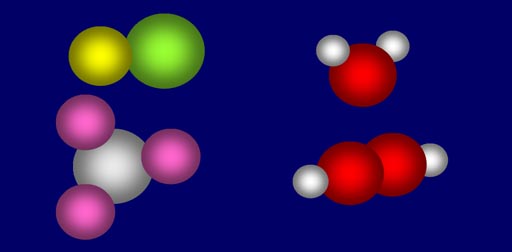
Here we see how hydrogen and oxygen (reactants) react and produce water.
It's a simple rearrangement.
Roll mouse over image to see animation.

In the tutorial on moles, we got into the art of counting atoms or molecules by knowing their weight in grams. In the tutorials on chemical equations, we learned about the types of chemical reactions (equations) and how to balance chemical equations. Now we want to put these two skills together.
Need for Water:
I like to do problems that involve survival. That way you've got a good reason to learn how to do these calculations.
Let's say you are planning an expedition into a desert and water will be critical. They say that a person needs about 1 gallon or 4 liters of water a day to stay alive.
You don't mind carrying extra water, but liquid water has its drawbacks...
Liquid water drawbacks:
If water is spilled, it will quickly be lost as it soaks into the sand.
If the water gets contaminated with poison, bacteria, or mold, it would be unsuitable to drink.
If open to the hot, dry air, it will evaporate.
In some areas, the value of water is so high that you risk being robbed of your water.
Therefore depending only on liquid water has many drawbacks.
Salt Hydrates as an answer:
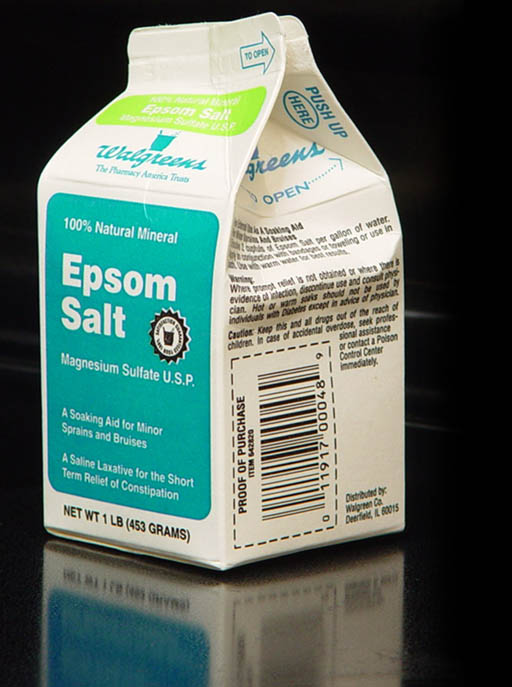
Many salts have water bound to the salt molecule. For example, Epsom salt has the formula of MgSO4•7H2O. This formula indicates that each magnesium sulfate molecule has 7 water molecules around it. The water that is bound to it will not evaporate in the sun nor get contaminated with microbes or poisons.
If spilled on the ground, it can be scooped up and salvaged.
Robbers won't recognize it as a water source.
The water will come free from the salt when heated with a flame.
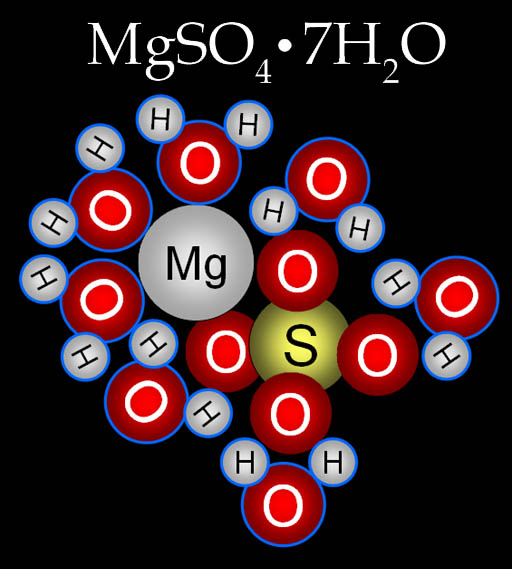
Here's the magnesium sulfate heptahydrate molecule. "Hepta" means "7" and "hydrate" means water.
When heated to 250°C, the water molecules are driven off. In a distillation apparatus, the water will condense and can be collected.
Now that we have a safe way to store some extra water, let's get back to our expedition planning. We need 4 liters per day per person. (Remember "per" is set up as a fraction. If you hear "per" twice, then both are in the denominator.) Notice that "persons" and "days" cancel.
4 liters x
2 persons x 3 days = 24 liters
day•person
Below are the same calculations but written in a table (spreadsheet) format. I prefer these tables because I can label each step and each box (cell) has an address. For example the answer of 24 liters is at cell addresses H2 and G2.
A |
B |
C |
D |
E |
F |
G |
H |
G |
|
1 |
Rate of water needed |
# persons |
# days |
||||||
2 |
4 |
Liters | 2 |
persons | 3 |
days | = |
24 |
Liters |
3 |
day · person | ||||||||
We need 24 liters of water. How many pounds of Epsom salts do we need to take in order for us distill off 24 liters of water?
When you hear a question that you have no idea how to answer, don't panic. You don't need to know how to do the problem right away. Just take it a step at a time.
You begin these kind of problems with a balanced chemical equation. This one is easy. The magnesium sulfate heptahydrate decomposes into anhydrous magnesium sulfate and 7 water molecules. "Anhydrous" means no water.
MgSO4•7H2O -> MgSO4 + 7H2O
The problem would be easy if it asked "How many magnesium
sulfate heptahydrate molecules do you need to make 14 water molecules?"
From the balanced equation we see that there is one
magnesium sulfate heptahydrate molecule for every 7
water molecules.
14 H2O x 1MgSO4•7H2O
= 2 MgSO4•7H2O
(1 is not written but understood)
7H2O
The thing to remember is that balanced equations are good at counting
the various molecules and seeing the ratio of one to the other. So that
means if we are given weight or volume, we must convert it to a number.
Moles is the preferred way to count these large numbers and because the
Periodic Table gives us weight per mole.
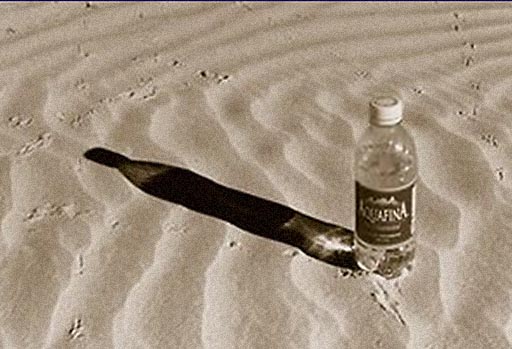
When dealing with water, it's easy to convert volume to weight. Once you have weight you can convert that to number (moles). Commit this to memory. A liter of water weighs 1,000 grams (1 kilogram).
We know we need 24 liters, so that's 24 kilograms or 24,000 grams.
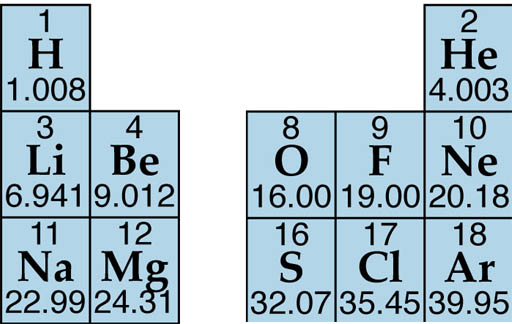
The formula for water is of course, H2O. We refer to these sections of the Periodic Table to find the weight of each mole of hydrogen and oxygen. One mole of hydrogen weighs 1.008 grams. One mole of oxygen weighs 16.00 grams. For a mole of H2O, we need two moles of hydrogen atoms. So the total weight of a mole of H2O molecules is 1.008 + 1.008 + 16.00 = 18.016 grams.
Now we have a conversion for weight to moles (from being weighed to being counted) by using 1 moler water for every 18.016 grams of water.
A |
B |
C |
D |
E |
F |
G |
|
1 |
Water needed in grams |
Grams to mole conversion |
Water counted in moles |
||||
2 |
24000 |
grams H2O | 1 |
mole H2O |
= |
1332 |
moles H2O |
3 |
18.016 |
grams H2O | |||||
Now that we have moles of water we can use the equation to figure out
the moles of the magnesium sulfate heptahydrate. Looking at the equation we see the number of water molecules is 7 times that as the molecules of magnesium sulfate heptahydrate.
MgSO4•7H2O -> MgSO4 + 7H2O
A |
B |
C |
D |
E |
F |
G |
|
1 |
24 liters counted in moles |
Molecule ratio from balanced equation 1:7 |
MgSO4·7H2O counted in moles |
||||
2 |
1332 |
moles H2O | 1 |
MgSO4·7H2O |
= |
190.3 |
moles MgSO4·7H2O |
3 |
7 |
H2O |
|||||
In the spreadsheet the math formula put into F2 (the answer) would be: =A2/C3
That will divide the 1332 by 7 giving us 190.3. You don't have to multiply by C2 because that's just a "1".
We know moles of Epsom salts, but the original question
is how many pounds of Epsom salts. Now we work backwards to find weight (mass).
To do that we need to know what one mole of magnesium sulfate heptahydrate
weighs. Just like water, we've got to go through the Periodic Table to
find the weight of one mole of each element in that compound.
Here are the two sections of the Periodic Table that we can look up the mass of one mole of each of these atoms. Magnesium is 24.31 grams per mole. Sulfur is 32.07 grams per mole. Oxygen is 16.00 grams per mole, but since there are 4 oxygen atoms in sulfate and 7 in the 7 waters, that's 11 oxygen atoms. So 11x16.00g.=176g of oxygen in a mole of the compound. Hydrogen is 1.008 grams per mole, but there are 14 of them because there are 7 waters. Those all add up to 246 grams for each mole of magnesium sulfate heptahydrate.
This is how we changed grams to moles for water:
24,000 grams x 1 mole H2O = 1332
moles
18.016
grams
Above we show the the Epsom salt is 1/7 the number of water molecules (1/7 of 1332moles=190.3moles) Now we need to do the reverse. Change moles to grams for Epsom salt
190.3 moles x 246 grams MgSO4·7H2O = 48716
grams of Epsom salt
1 mole
Notice that to cancel the moles, gram is on top and mole
is on the bottom.
In the USA we don't normally buy things in grams but in pounds. So let's do one final conversion (grams to lbs).
Commit this number to memory. One pound is 454 grams. If you look at the bottom of the box, you will see that they say 1 lb. = 453 grams. It is actually 453.6 grams. So 454 is rounded up and 453 is rounded down. I remember 454 because my old Corvette had a 454 cubic inch engine.
48716 g. x 1 lb. = 107 lbs.
454 g.
So we have our answer. 107 lbs of Epsom salt will release 24 liters of water ( about 53 lbs of water).
Epsom Salt costs about $1 per pound, so for $107 we can help guarantee our survival.
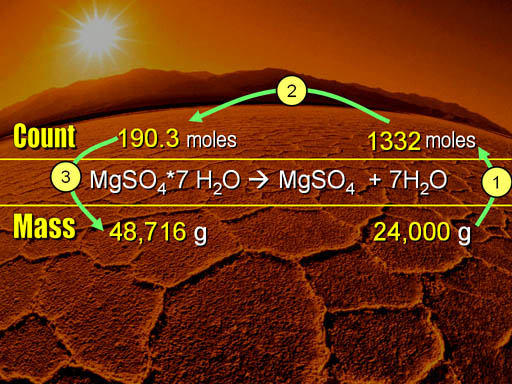
Here are the 3 steps that we followed. (1) We started with the 24,000 grams of water and converted that into the number of water molecules (1332 moles). (2) Using the 1 to 7 ratio in the balanced equation, we changed 1332 moles to 190.3 moles of magnesium sulfate heptahydrate. (3) That was converted to grams, and then to pounds.
With all of these calculations to do, you might prefer to just take your chances with the desert.
A |
B |
C |
D |
E |
F |
G |
H |
I |
J |
K |
L |
M |
N |
O |
P |
Q |
R |
S |
|
1 |
4 liters of water per day per person to survive | 24,000 g H2O at this point |
1332 mol H2O now | 190.3 mol of salt |
46,909 g Epsom salt |
lbs to survive | |||||||||||||
2 |
#persons & days |
g/L of water |
g to moles H2O |
balanced equation |
mol to g for Epsom salt | convert | Final lbs | ||||||||||||
3 |
4 |
Liters | 2 |
persons | 3 |
days | 1000 |
g | 1 |
mol H2O | 1 |
MgSO4·7H2O | 246.5 |
g. MgSO4·7H2O | 1 |
lb | = | 103 |
lbs |
4 |
day · person | 1 |
L | 18.016 |
g H2O | 7 |
H2O | 1 |
mol MgSO4·7H2O | 454 |
g | ||||||||
The beauty of the above dimensional analysis setup is that you can change the number of persons or the days and spreadsheet will calculate the new lbs of Epsom salts automatically. You don't have to go through all the steps again. In other words, once a spreadsheet is setup up, it can be used over and over with new input data. Also, instead of Epsom salts, you could find another hydrated salt and modify the molar mass to match the new hydrated salt and a new ratio to match the new balanced equation.
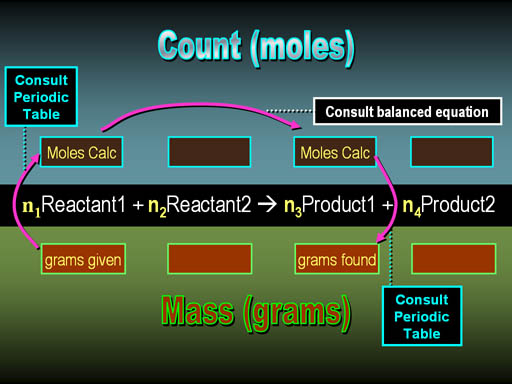
These kind of problems can be summarized by this graph. Typically the mass of a reactant or product is given. The mass of something else is asked for. In this example, the mass of the first reactant is given and the mass of the first product is asked for. The first step is to go from the grams given to its number of moles. One consults the Periodic Table to find the grams per mole of each element. From the moles of the given compound, you calculate the moles of the compound asked about. You use the balanced equation to see the ratio. Here it is "n1" and "n2". If "n1" is 1 and "n2" is 3, we know the moles of the product is three times larger. Finally, we convert these moles to grams again using the Periodic Table to lookup the grams per mole of each element in the compound.
If the mass or moles of any compound is given, the mass or moles of any other compound in the balanced chemical equation can be found.
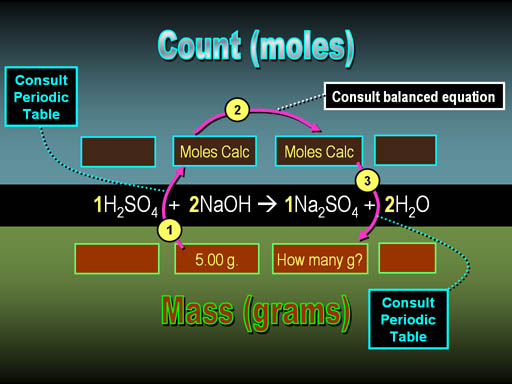
Let's do the math.
Na (sodium) is 22.99 grams per mole. Oxygen is 16.00,
and hydrogen is 1.008. Those add up to 40.00 grams per mole for NaOH
5.00 g. x 1 mole = 0.125 moles NaOH
40.00
g
(1) is finished. Now for (2). Note: "mol" is
abbreviation for "mole".
0.125 mol NaOH x 1 Na2SO4 = 0.0625 moles Na2SO4
2
NaOH
Normally the 1 in front of compounds is not shown. So
if you don't see a number, just assume it is 1.
(3) The last step is to convert the 0.0625 moles of Na2SO4
to grams. Consulting the Periodic Table above, we get 32.07 g/mol for
sulfur. 16.00 g/mol for oxygen (times 4) and 22.99 for Na (times 2). That
all adds up to 142 grams per mole of Na2SO4
0.0625 mol x 142 g. = 8.88 g.
1
mol
Notice "moles" are placed so that they cancel. So 8.88 grams
is the final answer.
A |
B |
C |
D |
E |
F |
G |
H |
I |
J |
K |
|
1 |
Starting grams given |
Turn g. NaOH to moles |
Ratio from balanced equation |
Turn moles Na2SO4 to grams |
Grams asked for |
||||||
2 |
5.00 |
grams NaOH | 1 |
mole NaOH | 1 |
molecule Na2SO4 | 142 |
grams Na2SO4 | = | 8.88 |
grams Na2SO4 |
3 |
40.00 |
grams NaOH | 2 |
molecules NaOH | 1 |
mole Na2SO4 | |||||
Problem 1: How many liters are needed for 5 people for 4 days? In other words, what is the answer at H2?
A |
B |
C |
D |
E |
F |
G |
H |
G |
|
1 |
Rate of water needed |
# persons |
# days |
||||||
2 |
5 |
Liters | 5 |
persons | 4 |
days | = |
? |
Liters |
3 |
day · person | ||||||||
Problem 2: Using the below spreadsheet as a guide, how many lbs of Epsom salts do you need to provide water for 5 people for 4 days?
A |
B |
C |
D |
E |
F |
G |
H |
I |
J |
K |
L |
M |
N |
O |
P |
Q |
R |
S |
|
1 |
4 liters of water per day per person
to survive |
#persons x days |
g/L of water |
g to moles H2O |
balanced equation |
mol to grams for Epsom salt |
convert | Final lbs | |||||||||||
2 |
4 |
Liters H2O | ? |
persons | ? |
days | 1000 |
g H2O | 1 |
mol H2O | 1 |
MgSO4·7H2O | 246 |
g. MgSO4·7H2O | 1 |
lb | = | ?? |
lbs |
| 3 | day · person | 1 |
L H2O | 18.016 |
g H2O | 7 |
H2O | 1 |
mol MgSO4·7H2O | 454 |
g | ||||||||
Instead of Epsom salts to obtain water, another common hydrated salt can be used. It is alum, which is found in the spice section of a grocery store. Alum is used in pickling of pickles and olives. The chemical equation for the dehydration of alum is:
KAl(SO4)2·12H2O --> KAl(SO4)2 + 12H2O
Problem 3: How many lbs of alum is needed to provide water for 5 people for 4 days? (Note: you will need to calculate the molar mass of alum for cell M2. Hint: Its molar mass is more than 400 but less than 500 g/mole)
A |
B |
C |
D |
E |
F |
G |
H |
I |
J |
K |
L |
M |
N |
O |
P |
Q |
R |
S |
|
1 |
4 liters of water per day per person
to survive |
#persons x days |
g/L of water |
g to moles H2O |
balanced equation |
mol to grams for Alum |
convert | Final lbs | |||||||||||
2 |
4 |
Liters H2O | 5 |
persons | 4 |
days | 1000 |
g H2O | 1 |
mol H2O | 1 |
KAl(SO4)2·12H2O | ??? |
g. KAl(SO4)2·12H2O | 1 |
lb | = | ??? |
lbs |
| 3 | day · person | 1 |
L H2O | 18.016 |
g H2O | ? |
H2O | 1 |
mol KAl(SO4)2·12H2O | 454 |
g | ||||||||
Here is the formula again for sulfuric acid neutralizing sodium hydroxide.
H2SO4 + 2NaOH -> Na2SO4 + 2H2O
Problem 4: Using the below spreadsheet as a guide, how many grams of water is produced when starting with 50.00 grams of NaOH?
A |
B |
C |
D |
E |
F |
G |
H |
I |
J |
K |
|
1 |
Starting grams given |
Turn g. NaOH to moles |
Ratio from balanced equation |
Turn moles H2O to grams |
Grams asked for |
||||||
2 |
50.00 |
grams NaOH | 1 |
mole NaOH | 2 |
molecules H2O | 18.016 |
grams H2O | = | ? |
grams H2O |
3 |
40.00 |
grams NaOH | 2 |
molecules NaOH | 1 |
moleH2O | |||||
Problem 5: Using the below spreadsheet as a guide, how many grams of water is produced if we started with 50.00 grams of H2SO4? (Note: You need to calculate molar mass of H2SO4 for cell C3.
A |
B |
C |
D |
E |
F |
G |
H |
I |
J |
K |
|
1 |
Starting grams given |
Turn g. NaOH to moles |
Ratio from balanced equation |
Turn moles H2O to grams |
Grams asked for |
||||||
2 |
50.00 |
grams H2SO4 | 1 |
mole H2SO4 | 2 |
molecules H2O | 18.016 |
grams H2O | = | ? |
grams H2O |
3 |
??? |
grams H2SO4 | 2 |
molecules H2SO4 | 1 |
moleH2O | |||||
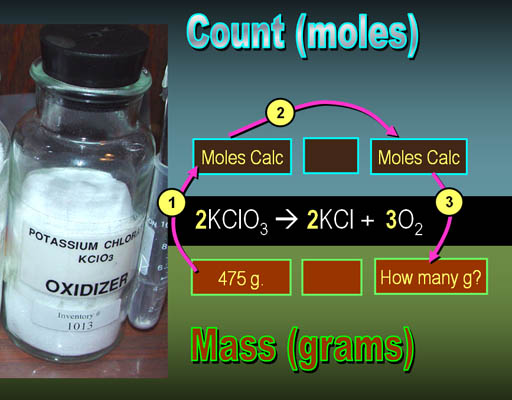
If locked in a room that was sealed from any air coming in, this jar of potassium chlorate (KClO3) could save your life. When heated, it decomposes into
KCl and O2.
Problem 6:
If this jar contained 445 grams of KClO3, how many grams of O2 is produced?
A |
B |
C |
D |
E |
F |
G |
H |
I |
J |
K |
|
1 |
Grams given |
g. KClO3 to moles |
Ratio from equation |
Moles H2O to g |
Grams O2 |
||||||
2 |
445 |
g KClO3 | 1 |
mole KClO3 | 3 |
molecules O2 | 32 |
grams O2 | = | ? |
grams O2 |
3 |
122.5 |
g KClO3 | 2 |
molecules KClO3 | 1 |
mole O2 | |||||
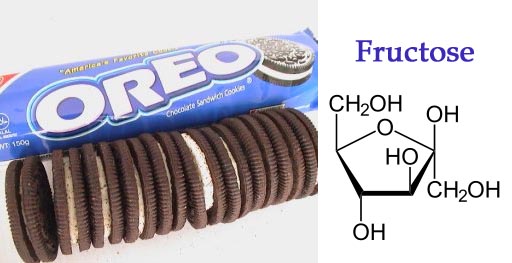
Fructose sugar is
burned in the Oreo rocket. Here's the unbalanced combustion formula:
C6H12O6 + O2 ->
CO2 + H2O
Problem 7:
What is the balanced formula?
Bonus: If 10 grams of fructose is burned, how many grams of water is produced?